Budget 2026: landlord tax rises to 24%, 44% and 49% from April 2027. What it actually costs you
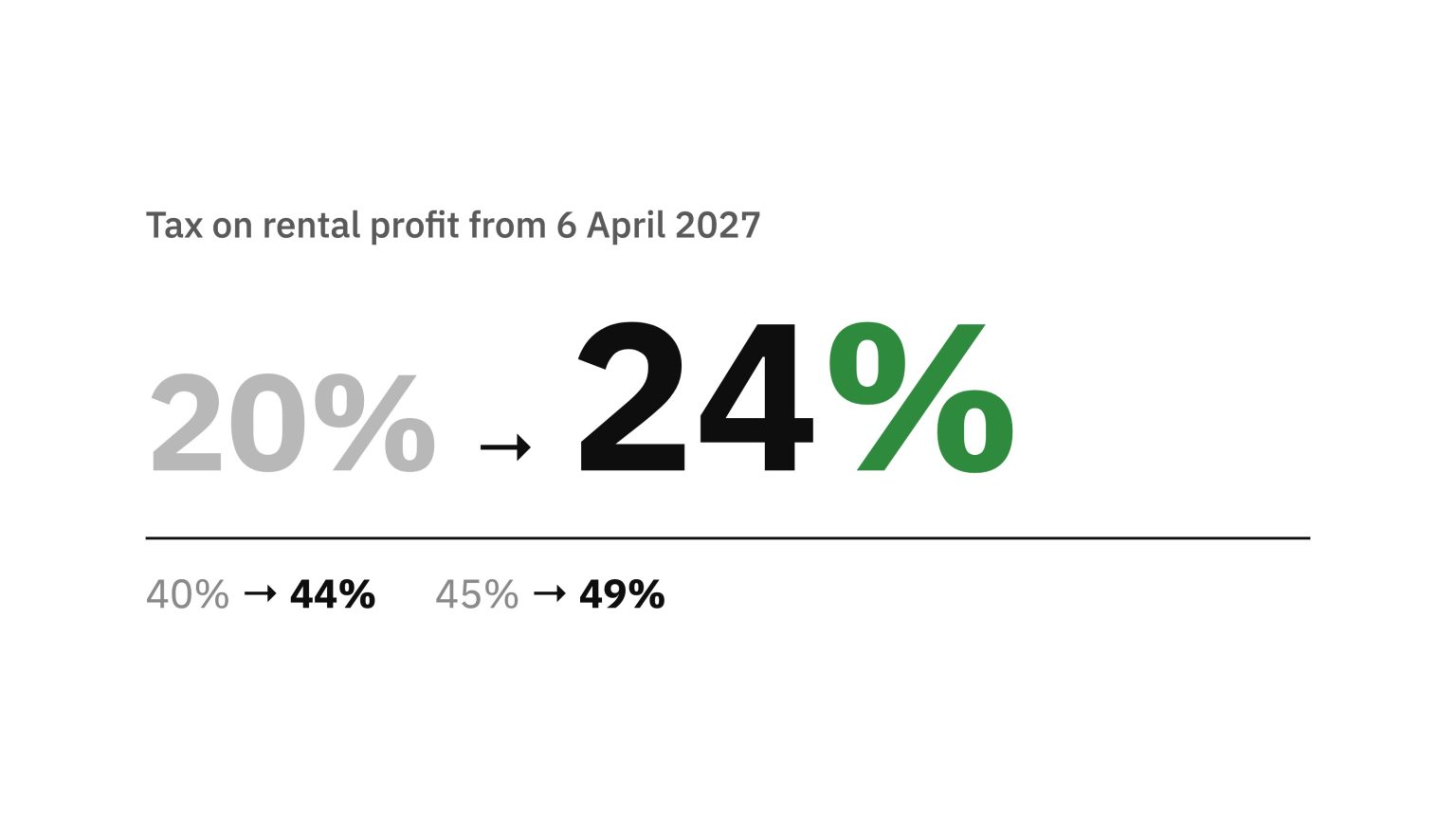

In a nutshell: From 6 April 2027, tax on rental income you receive in your own name goes up to 24%, 44% and 49%, four points above today’s 20%, 40% and 45%. The Section 24 credit on mortgage interest rises to 24% as well, so for most landlords the extra tax comes to roughly 4% of their profit after interest. Limited companies aren’t affected by the rise.
The Budget on 28 October 2026 announced a further two percentage point increase on top of the property income rates set last year for April 2027. The examples below explain the potential cost, subject to the proposed legislation.
In this article:
- What did the Budget on 28 October 2026 change for landlords?
- Who do the new rates apply to?
- What happens to the Section 24 credit on mortgage interest?
- How much more will I actually pay?
- What else in the Budget matters to landlords?
- What should I do before 6 April 2027?
- Landlord tax 2027: frequently asked questions
What did the Budget on 28 October 2026 change for landlords?
It raised the tax rates on property income from 6 April 2027 to 24%, 44% and 49%. That’s two points higher than the rates announced a year ago, and four points higher than today.
| Tax on rental income | Today (2026/27) | Earlier plan (2025 Budget) | From 6 April 2027 (Budget 2026) |
|---|---|---|---|
| Basic rate | 20% | 22% | 24% |
| Higher rate | 40% | 42% | 44% |
| Additional rate | 45% | 47% | 49% |
| Section 24 credit on mortgage interest | 20% | 22% | 24% |
The changes are set to be legislated in the Finance Bill 2026-27, which hasn’t been passed yet. So for now these are announced rates, not law. Tax rates on savings income are going up from 2027/28 too.
Who do the new rates apply to?
Individuals subject to the new property income rates in England, Wales and Northern Ireland, and relevant trusts. Taxpayer status matters, rather than the property location alone. This particular Income Tax rate increase does not apply to companies.
Corporation Tax qualification: the £50,000 and £250,000 limits assume a full accounting year and are reduced for associated companies. The 19% rate requires eligibility for the small profits rate; not every investment company qualifies.
If the property is in your own name, or jointly with someone else, this applies to you. Scottish taxpayer status requires a separate assessment; the location of the property alone does not determine it. These examples exclude Scottish taxpayers. A company letting property carries on paying Corporation Tax at the same rates as before: 19% on profits up to £50,000 and 25% above £250,000, with marginal relief in between. I look at whether that makes a company worth it in a separate article: Is a limited company finally worth it for landlords after Budget 2026?
What happens to the Section 24 credit on mortgage interest?
The credit follows the property basic rate, so it goes up from 20% to 24% from the 2027/28 tax year.
As a quick reminder, under Section 24 you can’t deduct mortgage interest from your rent. You pay tax on your profit before interest and then get a credit worth a percentage of the interest. I explain it step by step in Section 24 explained.
Here’s the bit that’s easy to miss. Because the rate on your profit and the credit on your interest both go up by four points, the extra tax works out at roughly 4% of what’s left after interest, whichever band you’re in. If your rent minus costs is £11,000 and your interest is £6,000, the rise costs you about 4% of £5,000, which is £200 a year. That holds as long as you stay in the same band and your credit isn’t restricted.
How much more will I actually pay?
For a single property with a basic rate landlord it can be around £200 a year. For a higher rate or additional rate landlord with a bigger portfolio, it runs into hundreds or thousands.
Calculation assumptions: the Personal Allowance is already used by other income, all income in each example falls within the stated band, finance cost relief is fully available, and losses or allowance withdrawals do not alter the result. These residential letting examples exclude Scottish taxpayers.
These are simplified examples with round numbers. They assume all the rental profit falls within one tax band, no other reliefs, and that the credit isn’t restricted. “Profit before interest” means rent less your other costs (letting agent, repairs, insurance and so on), but before mortgage interest.
Scenario 1: one property, basic rate taxpayer
Rent £12,000 a year, mortgage interest £6,000, other costs £1,000, so profit before interest is £11,000.
| £ a year | Today (2026/27) | Earlier plan | From April 2027 |
|---|---|---|---|
| Tax on £11,000 | 2,200 (20%) | 2,420 (22%) | 2,640 (24%) |
| Credit on £6,000 interest | less 1,200 (20%) | less 1,320 (22%) | less 1,440 (24%) |
| Tax to pay | 1,000 | 1,100 | 1,200 |
That’s £200 a year more than today, and £100 more than under last year’s plan.
Scenario 2: higher rate taxpayer, £20,000 profit and £10,000 interest
This is the example that’s been doing the rounds in the press since the Budget.
| £ a year | Today (2026/27) | Earlier plan | From April 2027 |
|---|---|---|---|
| Tax on £20,000 | 8,000 (40%) | 8,400 (42%) | 8,800 (44%) |
| Credit on £10,000 interest | less 2,000 (20%) | less 2,200 (22%) | less 2,400 (24%) |
| Tax to pay | 6,000 | 6,200 | 6,400 |
So £400 a year more than today, and £200 more than the earlier plan.
Scenario 3: a small portfolio, additional rate taxpayer
Say you’ve got several properties bringing in £40,000 of profit before interest, with £15,000 of mortgage interest, and all of it sits in the additional rate band.
| £ a year | Today (2026/27) | Earlier plan | From April 2027 |
|---|---|---|---|
| Tax on £40,000 | 18,000 (45%) | 18,800 (47%) | 19,600 (49%) |
| Credit on £15,000 interest | less 3,000 (20%) | less 3,300 (22%) | less 3,600 (24%) |
| Tax to pay | 15,000 | 15,500 | 16,000 |
That’s £1,000 a year more than today, every year, on the same rent.
Your own figures will differ, especially if your rental profit straddles two bands. That’s exactly where it’s worth sitting down with the numbers.
What else in the Budget matters to landlords?
Making Tax Digital reaches more landlords from April 2027, and there’s a new council tax surcharge on very expensive homes in England from April 2028.
- Making Tax Digital for Income Tax generally applies from 6 April 2027 where combined gross qualifying income from self-employment and property for 2025/26 exceeds £30,000, subject to exemptions. The threshold concerns income before expenses, not profit. For those already in MTD, the second quarterly update is due by 7 November 2026.
- High Value Council Tax Surcharge in England was first announced in 2025 and is due from 1 April 2028 for owners of residential property valued at £2 million or more. Initial annual charges are £2,500 to £7,500. Budget 2026 develops its design. Liability falls on the owner, rather than automatically on the tenant paying ordinary Council Tax.
What should I do before 6 April 2027?
Work out what the new rates cost you on your own figures, get ready for MTD if you’re over £30,000, and don’t rush into restructuring.
- Run your 2027/28 numbers. Take this year’s rent, interest and costs and work out the tax at 24%, 44% or 49%, less the 24% credit. Then you know what you’re dealing with.
- Check your band. If your rental profit pushes part of your income into a higher band, the rise bites harder on that slice.
- Review the timing of repairs individually. The year of relief depends on your accounting basis, when the expense is recognised and whether the work is a deductible repair or capital improvement. A higher future rate alone is not a sufficient reason to delay necessary work.
- Get MTD sorted. If your qualifying gross income for 2025/26 exceeds £30,000, choose your software now rather than in March. We work in Xero, which handles the quarterly updates.
- Plan new purchases separately. If you’re buying another property, it’s worth comparing your own name with a limited company, because companies aren’t hit by this rise.
- Don’t move existing properties on a whim. Moving them into a company can trigger Capital Gains Tax and Stamp Duty Land Tax, with the 5% surcharge on additional properties, plus mortgage and legal costs. Whether it pays has to be worked out individually.
Landlord tax 2027: frequently asked questions
When do the new landlord tax rates start?
From 6 April 2027, which is the start of the 2027/28 tax year. Until then, rental income is taxed at 20%, 40% and 45%, with a 20% credit on mortgage interest.
Are limited companies affected by the rise?
No. The higher rates apply to individuals and trusts. A company letting property still pays Corporation Tax at 19% on profits up to £50,000 and 25% above £250,000, with marginal relief in between, and deducts mortgage interest in full.
I’m a basic rate taxpayer. Will I pay more?
Potentially. Taxable rental income in the basic band is due to be taxed at 24% instead of 20%, with finance cost relief at 24%. With Personal Allowance already used elsewhere, £11,000 profit before interest and £6,000 eligible interest gives a £200 increase. Unused allowances or restricted relief change the result.
Does the rise apply in Scotland?
Scottish taxpayer status, rather than the location of the rental property alone, determines the relevant regime. These examples exclude Scottish taxpayers; their 2027/28 rates and finance cost relief require a separate assessment.
Is the rise definitely going ahead?
It’s been announced and is due to be legislated in the Finance Bill 2026-27, which hasn’t been passed yet. It’s sensible to plan on the basis that it will happen, and we’ll update this article if anything changes.
The key points
From 6 April 2027, rental income in your own name is taxed at 24%, 44% and 49%, and the Section 24 credit rises to 24%. For most landlords the extra cost is roughly 4% of profit after interest, so £200 on a modest single property and £1,000 or more on a larger portfolio. Companies aren’t affected. Before you change anything, work it out on your own figures.
Want to know what the 2027 rates cost you? Book a free 15 minute call with Marcin Udała ACMA. No obligation, by phone or video. Fill in the short form and we’ll run your numbers before we speak. Rather pick up the phone? Call 0161 505 2712.
More about how we work with landlords: accountancy for property investors.
Sources and verification
- HMRC: Property and savings income rates announced in Budget 2026
- HM Treasury: Budget 2026 rates and allowances
- HMRC: Technical note on property income and finance cost relief
- HMRC: Making Tax Digital for Income Tax
- HM Treasury: High Value Council Tax Surcharge
- HMRC: BADR lifetime limit
This isn’t tax advice. The article is for general information only and reflects the Budget announcements as they stood when it was published. The new rates still need to be passed by Parliament. Decisions about how you hold your properties are best made on your own figures and paperwork.
Managing Director at Accountancy4You. A CIMA qualified accountant who lets property himself and works with landlords and businesses across the UK.